Quick Answer
You can tell your business is still founder-dependent when routine decisions, client issues, priorities, quality checks, or cross-team handoffs repeatedly pause until you are available. The useful test is not whether you work hard. It is whether normal work can move with the same confidence when you step away for a day, a week, or a client conversation.
The Core Idea
Founder dependence is not the same as founder leadership.
Healthy founder leadership means you remain accountable for the direction of the company, the big tradeoffs, the culture, and the decisions that genuinely need your level of judgment.
Founder dependence is different. It happens when the business needs you for normal operating movement: routine decisions, ordinary client questions, priority clarification, quality checks, recurring exceptions, and the handoffs that should already have an owner.
That distinction matters because a founder can be highly involved and still not be the bottleneck. If the team knows what it owns, how to decide, where to find context, and when to escalate, your involvement can be strategic rather than structural.
The opposite is also true. A founder can have a full team, polished processes, and a busy calendar while the business still depends on them as its hidden coordination layer.
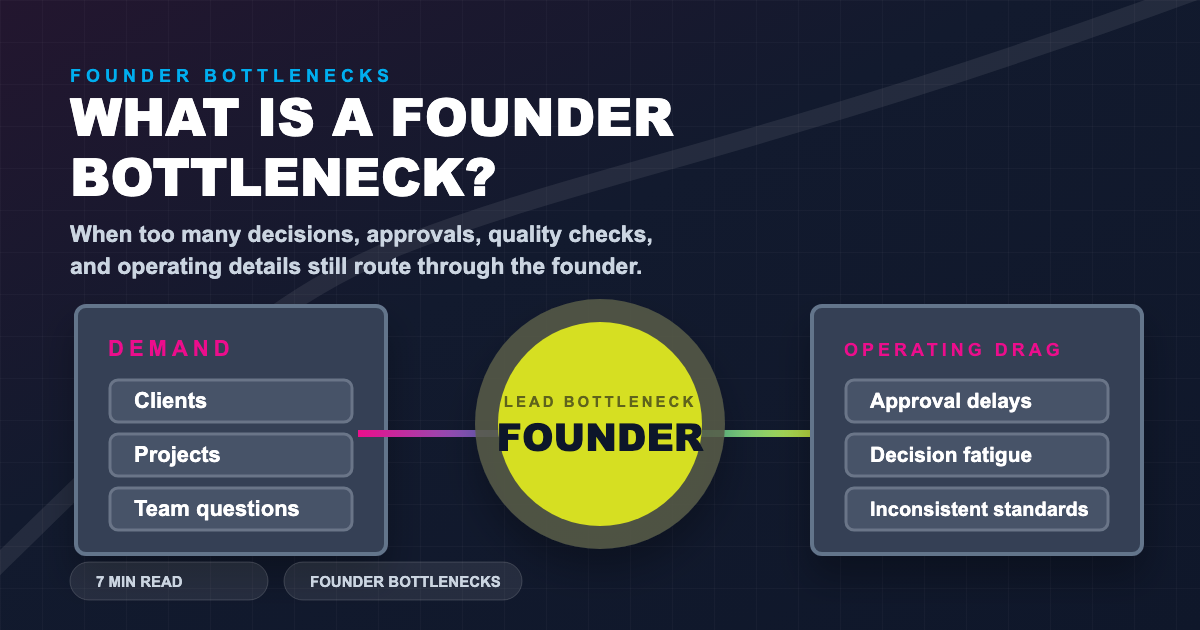
If you want the foundational definition, start with What Is a Founder Bottleneck?. This article helps you test whether that pattern is active in your business right now.
Why This Happens
Founder dependence usually begins as a strength.
You built momentum by knowing the customer better than anyone else. You could hear a weak client request and recognize the hidden risk. You knew which delivery shortcut was safe, which team member needed more context, and which opportunity was worth saying no to.
At an early stage, holding that picture in your head can make the business fast.
The issue emerges when the business grows and your judgment remains mostly invisible. The team receives the answer, but not the decision rule. They see the correction, but not the quality standard. They hear the priority, but not the tradeoff behind it.
Over time, people learn that checking with the founder is safer than acting. The founder learns that stepping in is faster than explaining. Both responses are understandable. Together, they create a business that relies on availability instead of structure.
This is why founder dependence is rarely solved by telling people to be more accountable. The business needs clearer ownership, usable standards, decision boundaries, shared context, and a rhythm for surfacing risks before they become interruptions.
The Evidence To Look For
The strongest evidence is not a feeling of being busy. Look for the repeatable patterns below.
Normal decisions wait for you when you are asked to choose between options that sit inside someone else's role. The question may be framed as a quick check, but it becomes a habit. Over time, the team loses speed and you become the queue for ordinary work.
Quality is difficult to explain without your involvement when people can complete the work, but you still need to review it because the quality bar exists more in your taste and client knowledge than in usable examples, criteria, or feedback loops.
Client context lives in conversations, not in the business, when the team needs you to remember promises, sensitivities, history, and exceptions. A client relationship can feel stable until you are not available to translate what matters.
The business slows when you are out of the loop. Take a close look at what happens when you are in meetings, on vacation, or focused on a new initiative. If decisions pile up, cross-team work waits, or the same questions return when you come back, that is evidence of dependency.
Managers coordinate upward instead of across when they may each be capable, but you still have to reconcile priorities and settle tradeoffs between them. The issue is not necessarily the people. It may be that no shared decision forum, ownership model, or tradeoff rule exists between functions.
You keep solving the same category of problem when the details change but the reason you are pulled in stays the same. Repeated scope questions, delivery exceptions, approval requests, or priority conflicts are signals of missing structure, not a string of unrelated emergencies.
One or two of these patterns may be normal during a transition. Four or more appearing consistently is a strong reason to diagnose the operating system rather than simply work harder around it.
The PROGRESS Lens
Capture the actual places work waits, repeats, or returns to you over the next two weeks.
Identify the pattern behind those returns: unclear authority, missing context, quality uncertainty, weak handoffs, or competing priorities.
Define what normal work should be able to move without your direct involvement.
Name the leadership capacity you would regain if fewer routine matters depended on your availability.
Determine what the owner needs to act well: examples, information, tools, decision boundaries, or support from another role.
Notice where dependence creates risk for client trust, margin, team confidence, delivery speed, or your ability to step away.
Connect the change to the company you are building and the founder role you want to hold next.
Choose one recurring return pattern and install the smallest structural fix that makes it less likely to come back.
Mini Case
Consider the founder of a growing professional-services company. She has capable delivery leads, healthy demand, and strong client retention. Yet every week, she is pulled into client changes, staffing choices, delivery tradeoffs, and priority conflicts.
Her first conclusion is that she needs a stronger operations hire.
When she tracks the return points for two weeks, a different picture appears. The delivery leads have authority over tasks but not the end-to-end client outcome. The sales and delivery teams have no shared rule for scope changes. Client history is scattered across email, messages, and the founder's memory. The weekly leadership meeting is mostly status updates, so decisions arrive late and individually.
The problem is not a lack of effort or a lack of people.
It is that the business has no reliable place for client tradeoffs, no clear owner for cross-functional decisions, and no shared source of truth for the context that shapes delivery.
The founder does not need to vanish. She needs the operating system to carry more of the work she has been carrying personally.
If the business has grown but your personal involvement has grown with it, Why Your Business Cannot Grow Without You explains the six bottleneck patterns that often sit beneath this evidence.
What To Do Next
Start by collecting evidence instead of declaring yourself the problem.
Track the return points
For two weeks, note every question, decision, approval, exception, and follow-up that returns to you. Record the outcome it protects, not only the task.
Find the repeated pattern
Group the returns by category, such as decision rights, client context, quality, priorities, handoffs, or cross-functional tradeoffs.
Choose the most expensive dependency
Select the pattern creating the greatest delay, rework, risk, or founder load. Do not try to solve all six at once.
Name the missing structure
Decide what would let the work move safely: one accountable owner, a decision rule, a visible standard, a shared source of truth, or a regular operating review.
Test one structural change
Install the smallest useful fix for two to four weeks, then watch whether that category of work returns less often and whether the owner can move with confidence.
Common Mistakes
Avoid treating a dependency pattern as a character issue.
Measuring busyness instead of dependency
A full calendar does not prove founder dependence. Watch whether normal work can move well when you are unavailable.
Delegating the task but keeping the judgment
The team cannot own the outcome if only the founder understands the standard, the tradeoff, or the risk threshold.
Trying to document everything at once
Start with the repeated return pattern. Documentation that solves no active decision or handoff problem will not reduce dependence.
Hiring before defining the problem
Another person may inherit the same unclear authority, missing context, and founder-centered coordination.
Treating every escalation as failure
Some work should come to the founder. The goal is to make those escalation rules deliberate, limited, and useful.
Fixing the loudest interruption first
The most urgent issue may be a symptom. Look for the repeatable pattern causing the greatest downstream drag.