Quick Answer
If your business cannot grow without you, the business is still depending on founder judgment to move normal work.
If your business cannot grow without you, it usually means one or more founder bottlenecks are still active. Normal work may still depend on you for decisions, quality control, client context, priorities, handoffs, or problem solving. The fix is not simply to delegate more. The fix is to identify where work keeps routing back to you, then turn that missing founder judgment into shared structure the team can use.
The Core Idea
The business may have grown, but the operating system may not have.
A founder-led company often grows because the founder is good at holding complexity.
You know the clients.
You know the standards.
You know which exceptions matter.
You know which team member needs context.
You know which opportunities are worth pursuing and which ones will create drag later.
That judgment is valuable. It is often the reason the business got traction in the first place.
But the same strength can become the ceiling.
When the business grows, the number of decisions, handoffs, client expectations, team questions, exceptions, and tradeoffs grows too. If those things still depend on the founder, growth does not create freedom. It creates more founder load.
That is why a business can look successful from the outside while still feeling fragile from the inside.
The founder is not just doing tasks.
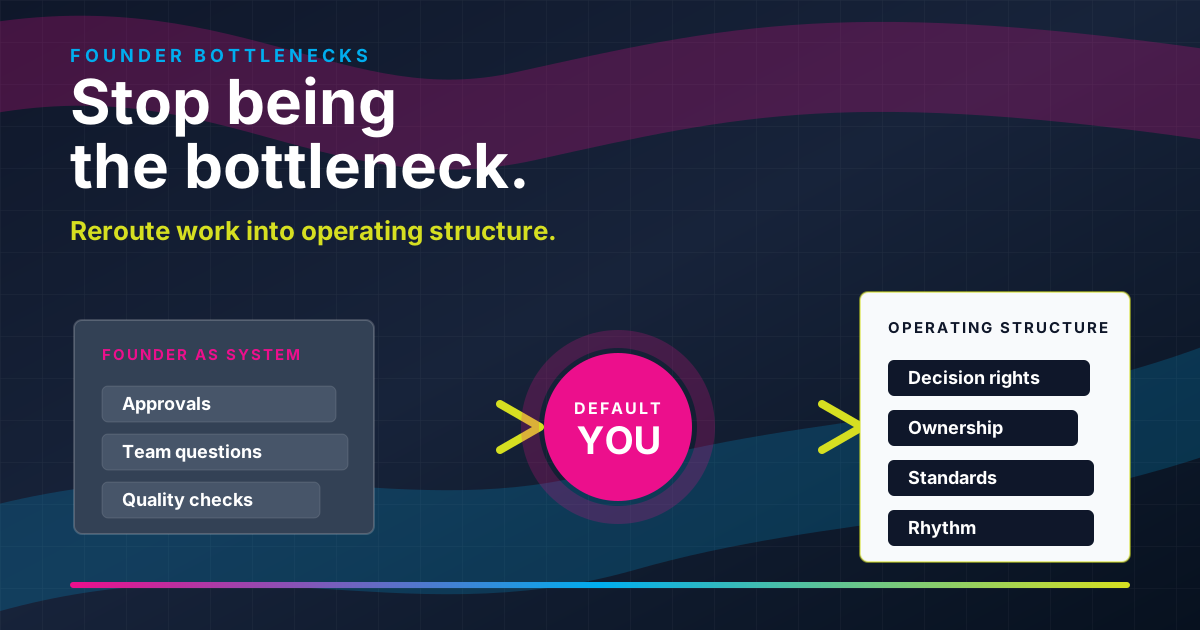
The founder is acting as the operating system.
The work moves because the founder remembers, connects, decides, clarifies, checks, adjusts, and protects quality.
The business cannot grow without you because too much of how it works still runs through you.
If that shows up as a daily stream of questions and escalations, start with what to do when everything in the business still comes back to you. It helps you separate the recurring pattern from the latest interruption.
Why This Happens
Founder dependence is often created by success, not failure.
In the early stage, founder involvement is useful.
It helps the business move quickly. It keeps quality high. It protects client trust. It lets the company adapt before every process is fully defined.
But the early operating model usually depends on invisible founder judgment.
The founder knows the standard, but the team has not seen enough examples.
The founder knows when to escalate, but the decision rights are not clear.
The founder knows the client history, but the context is not stored anywhere useful.
The founder knows what matters most, but the team does not have a working priority filter.
The founder knows which opportunity is a distraction, but the tradeoff rule has never been named.
At small scale, this is manageable.
At the next stage, it becomes drag.
The team may be capable. The offer may be strong. Demand may be real. But the operating structure has not caught up with the size of the business.
That is the shift from founder-led momentum to founder dependence.
To prepare for the next stage, use these five moves to build operating architecture before growth breaks it. If ownership and handoffs are already the weak point, work through six steps to build roles, workflows, and ownership that scale.
The 6 Places Growth Usually Gets Stuck
Founder dependence usually shows up in one of six bottlenecks.
If your business cannot grow without you, do not assume the answer is simply "delegate more."
Delegation only works when you know what is actually getting stuck.
The founder bottleneck may be one of six patterns:
- Decision Bottlenecks: The team waits because authority, standards, risk thresholds, or escalation rules are unclear.
- Operational Redundancy: The business still runs on founder memory, repeated explanations, and context stored in your head.
- Resource and Tech Constraints: People, tools, or automation have been added, but they do not reduce founder dependence because the workflow is unclear.
- Growth vs. Chaos: More clients, projects, and opportunities create complexity faster than the operating structure matures.
- Significance and Vision Gaps: The founder carries the direction, priorities, and tradeoff filters, so the team needs repeated interpretation.
- Team Alignment Gaps: Ownership feels shallow because outcomes, authority, handoffs, standards, and review rhythm are not clear enough.
The lead bottleneck matters.
If the issue is decision rights, a new SOP may not help.
If the issue is founder memory, another meeting may not help.
If the issue is shallow ownership, more software may not help.
If the issue is growth complexity, hiring one more person may add coordination before it creates relief.
The goal is to diagnose the specific pattern that keeps the business dependent on you.
Once you can name that pattern, follow the five steps to get out of day-to-day operations without losing control. The aim is to transfer the structure behind your involvement, not simply disappear from the work.
The PROGRESS Lens
Where does growth currently require your personal involvement before work can move?
Which bottleneck is most responsible: decisions, memory, resources, growth complexity, vision, or ownership?
What should the business be able to do without routing normal work through you?
What would change for your time, attention, leadership, and life if this bottleneck improved?
What structure, role clarity, tool, source of truth, or operating rhythm would support the team?
Where is the business fragile because clients, quality, decisions, or context still depend on you?
Why does solving this bottleneck matter for the next version of the business and your role in it?
What is the smallest operating change that would reduce the most founder dependence first?
Mini Case
The founder had growth, but not more leverage.
Imagine a founder-led service business with steady demand.
Revenue is up. The team has grown. The offer is clearer than it was two years ago.
From the outside, things look healthy.
Inside the business, the founder is exhausted.
Every new client creates more questions. Every new hire needs more context. Every project creates exceptions. The team is working hard, but the founder still reviews the important work, handles sensitive client issues, decides priorities, and explains why certain tradeoffs matter.
The founder thinks the problem is time.
But the deeper issue is structure.
The business has added volume without transferring enough founder judgment into the operating system.
Once the founder maps the bottleneck, the pattern becomes clearer.
Client exceptions need escalation rules. Quality needs examples and standards. Recurring questions need a source of truth. The team needs clearer decision rights. The founder needs a review rhythm that protects quality without becoming the default checkpoint for everything.
The founder does not disappear.
The founder stops being the only way the business knows how to move.
What To Do Next
Find the place where growth still routes through you.
List the return points
Write down the decisions, questions, approvals, and exceptions that keep coming back to you.
Group the pattern
Sort them into decisions, memory, resources, growth complexity, vision, or ownership.
Choose the lead bottleneck
Pick the pattern that creates the most delay, rework, or founder load.
Name the missing structure
Decide whether the team needs clearer authority, standards, context, handoffs, rhythm, or priority filters.
Install one small fix
Start with one operating change that reduces founder dependence in a visible place.
Review the effect
Watch whether questions, approvals, delays, or rework decrease over the next two weeks.
Common Mistakes
Avoid treating founder dependence as a personal productivity problem.
Trying to work faster
Speed can help for a week, but it does not change the structure that routes work back to you.
Delegating without decision rights
People cannot truly own work if they still need you to approve normal decisions.
Hiring before diagnosing the bottleneck
More people can create more coordination if ownership and workflow are unclear.
Writing SOPs for judgment problems
Documentation helps, but some issues need examples, standards, thresholds, and review rhythm.
Blaming the team too quickly
Capable people can still act dependent inside a system that requires founder interpretation.
Waiting for the perfect operating model
You do not need to redesign everything. Start with the bottleneck creating the most drag.