Quick Answer
If everything in your business comes back to you, map the return pattern before choosing the fix.
Everything may come back to you because people need decisions, context, approval, quality standards, priority filters, or escalation support. Those are different bottlenecks. Once you see the pattern, you can install the missing structure instead of becoming the default answer to every question.
The Core Idea
Everything comes back to you because the business is using you as the operating route.
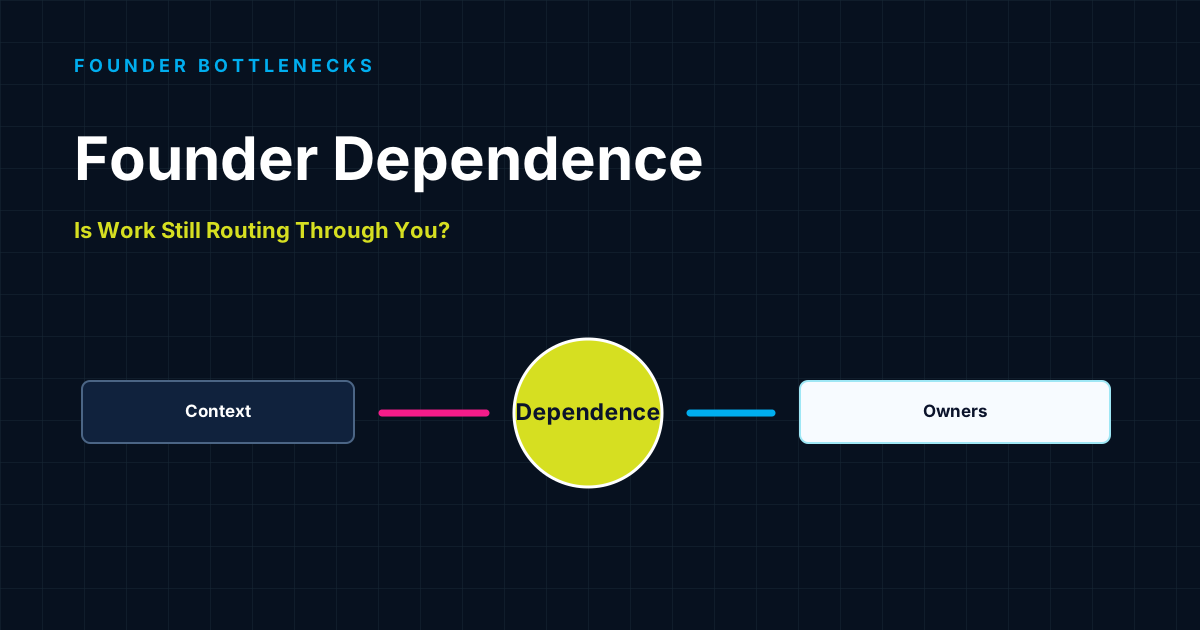
When a founder says, "Everything comes back to me," they are usually describing a routing problem.
Questions route to the founder.
Decisions route to the founder.
Client exceptions route to the founder.
Quality concerns route to the founder.
Priorities route to the founder.
Team uncertainty routes to the founder.
This can happen even with a capable team.
The issue is not always willingness.
The issue is that the business still relies on the founder as the place where context, judgment, standards, and authority come together.
That may have worked when the company was smaller.
But as the business grows, the founder becomes the intersection for too many paths.
The fix is not to block the team from asking.
The fix is to understand why the question has nowhere else to go.
Why This Happens
Return patterns are usually symptoms of missing operating structure.
If a question comes back once, it may be normal.
If the same kind of question keeps coming back, it is a signal.
The business may be missing a decision rule.
It may be missing a source of truth.
It may be missing a quality standard.
It may be missing an owner.
It may be missing a handoff.
It may be missing a priority filter.
It may be missing a review rhythm.
Founders often treat all of these as interruptions.
But the interruptions are data.
They show where the business still depends on the founder to interpret the work.
Once you sort the interruptions, the next fix becomes clearer.
Sort What Keeps Coming Back
The return pattern tells you what structure is missing.
Start by grouping what returns to you.
- Decisions: People need approval, tradeoff calls, or risk judgment.
- Memory: People need context, history, standards, or repeated explanations.
- Resources: People have tools or roles but still cannot move because support is unclear.
- Growth complexity: More clients, projects, and priorities create coordination drag.
- Vision: People need you to restate what matters or interpret strategic tradeoffs.
- Ownership: People do tasks, but no one fully owns the outcome.
Each pattern points to a different fix.
Decision problems need decision rights.
Memory problems need operating memory.
Resource problems need clearer workflow and support.
Growth complexity needs roles, cadence, and visibility.
Vision problems need priorities, filters, and tradeoff rules.
Ownership problems need outcomes, authority, standards, and review rhythm.
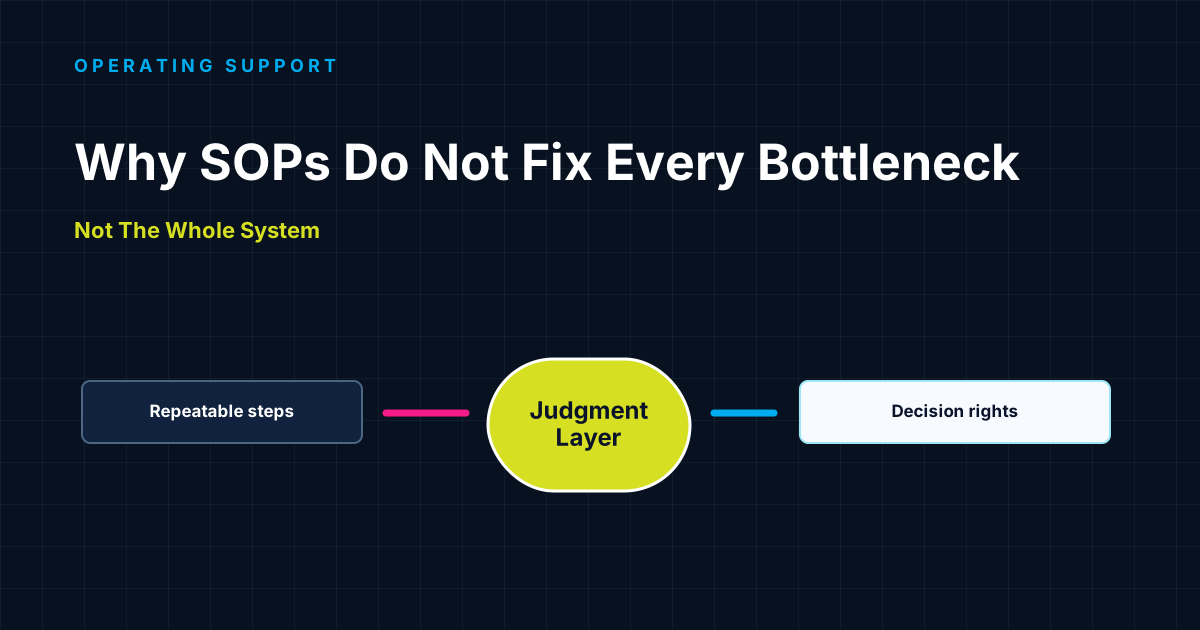
This is why generic delegation advice often falls short.
The founder needs to know what kind of dependence is active.
The PROGRESS Lens
List what keeps coming back to you in a normal week.
Sort the return points into decisions, memory, resources, growth complexity, vision, or ownership.
Define what should move without routing through you.
Name what would change for your focus, energy, and leadership if the pattern improved.
Identify the structure the team needs: authority, context, standards, support, or rhythm.
Surface the risk if the pattern continues, such as slower delivery, weaker ownership, or founder burnout.
Connect the fix to the business you are trying to build beyond founder dependence.
Choose one return pattern and install the smallest structure that reduces it.
Mini Case
The founder thought everything was the problem.
Imagine a founder who feels buried by interruptions.
The team asks about client requests. Delivery needs quality review. Sales asks whether a prospect is a good fit. Operations needs approval on exceptions. Priorities keep shifting.
The founder thinks the problem is that no one owns anything.
But after tracking the interruptions for one week, a clearer pattern appears.
Most returns are not ownership problems.
They are decision problems.
The team does not know which client exceptions they can approve, which ones create risk, and which ones should escalate.
The founder creates a decision lane for client exceptions.
Within two weeks, the number of approval questions drops.
Not everything is fixed.
But the founder no longer treats the whole business as one giant problem.
The lead return pattern is visible.
Now the next fix can be chosen with less guessing.
What To Do Next
Track, sort, and fix one return pattern.
Track one week
Write down every question, decision, approval, exception, or clarification that comes back to you.
Label the reason
Mark whether each return was about decision, memory, resource, growth complexity, vision, or ownership.
Find the cluster
Look for the pattern that repeats most often or creates the most drag.
Name the missing structure
Decide what would let that work move without you.
Install one fix
Create one decision rule, standard, handoff, owner, source of truth, or review rhythm.
Measure the change
Watch whether that type of interruption decreases over the next two weeks.
Common Mistakes
Avoid trying to fix every return point at once.
Treating all interruptions the same
Different return patterns need different operating fixes.
Delegating harder without diagnosing
More delegation does not help if the missing layer is authority, memory, or standards.
Hiring too early
A new person may add more questions if the workflow and decision rights are unclear.
Documenting everything
Documentation helps only when it is connected to the work and decision pattern.
Taking questions personally
Repeated questions often reveal a system gap, not a character flaw.
Solving the loudest issue instead of the lead pattern
The most urgent interruption may not be the bottleneck creating the most drag.