Quick Answer
Employees wait for the owner to make decisions when authority is unclear.
If employees keep waiting for you to make decisions, the issue is often not motivation. It is usually unclear decision rights. The team may not know who owns the decision, what standard should guide the tradeoff, what level of risk is acceptable, or when escalation is truly required.
The fix is to choose one recurring decision and define the owner, standard, risk threshold, and escalation rule so the team can act without guessing.
The Core Idea
Your team waits because founder judgment has not become operating structure.
In the six founder bottlenecks, this pattern sits under Decision Bottlenecks.
That matters because it changes the fix.
If you think the issue is motivation, you will push the team to be more proactive.
If you see it as a decision bottleneck, you will ask a better question: what decision logic still lives with the founder that the business needs to learn how to use?
Most founders want their team to make more decisions.
But many teams are operating inside an invisible rule:
When the decision feels important, unusual, client-sensitive, expensive, or risky, bring it back to the founder.
That rule may never have been written down.
It may never have been said out loud.
But the business learns it through repetition.
The founder makes the hard call. The founder catches the nuance. The founder remembers what happened last time. The founder knows which client exception matters. The founder understands the financial tradeoff. The founder sees the reputational risk.
Over time, the team learns that certain decisions are safer when the founder decides.
This creates a decision bottleneck.
The founder becomes the place where uncertainty goes to be resolved.
At first, that can protect quality. It keeps the business from making avoidable mistakes.
But as the company grows, the same pattern slows the business down. Decisions queue up. Team members lose practice making judgment calls. The founder gets pulled into details that should no longer require founder attention.
The fix is not simply to say, "I trust you. Just decide."
Trust helps, but trust is not a decision system.
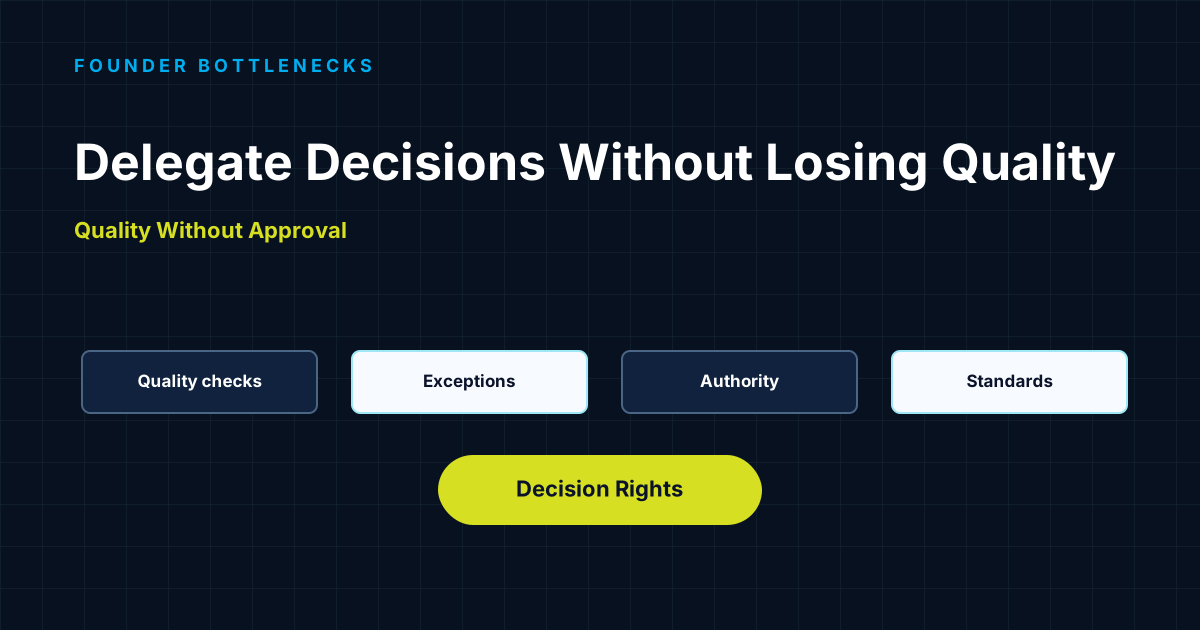
The real shift is to translate founder judgment into decision rights, standards, risk thresholds, and escalation rules the team can use without guessing.
Why This Happens
The founder has context the team cannot see.
Founder-led businesses usually start with one person holding most of the context.
You know the promises made to clients. You know the financial pressure behind the scenes. You know which clients are flexible and which ones are fragile. You know why a past decision failed. You know which quality details matter because you have absorbed years of feedback, consequences, and pattern recognition.
That context gives you judgment.
But it also creates a gap.
To the team, a decision may look like a simple choice between option A and option B. To you, the decision includes client trust, margin, delivery risk, team capacity, brand positioning, future precedent, and timing.
When people sense that you see more than they see, they hesitate.
Sometimes they wait because they do not know the answer.
Sometimes they wait because they know there is a hidden tradeoff.
Sometimes they wait because the business has punished mistakes more clearly than it has defined decision authority.
Sometimes they wait because "ownership" has been assigned, but authority has not.
This is why founder decision bottlenecks are so sticky. The founder is not just approving work. The founder is carrying the decision logic underneath the work.
Until that logic becomes visible, the team has to keep coming back.
What Decision Rights Actually Mean
Decision rights define who can decide, within what boundary, using what standard.
Decision rights are not a motivational speech about empowerment.
They are a practical operating tool.
Good decision rights answer four questions:
- Who owns this decision?
- What standard should guide the decision?
- What risk level can the owner accept without escalation?
- When should the decision come back to the founder?
Without those answers, autonomy becomes vague.
One person may think they are empowered to decide. Another may assume the founder still wants the final call. A manager may own the task, but not the tradeoff. A team member may have responsibility, but not enough authority to move.
That is where work gets stuck.
The founder says, "Why are you waiting for me?"
The team silently wonders, "Am I actually allowed to decide this?"
Decision rights remove that ambiguity.
They do not remove founder involvement from every decision. Some decisions should still come back to you. The goal is not founder absence. The goal is founder involvement by design instead of by default.
The PROGRESS Lens
Identify which decisions still route through the founder today and whether they are routine, risky, strategic, or unclear.
Find the real blocker: missing authority, unclear standards, low confidence, hidden risk, or weak escalation rules.
Define what the team should be able to decide without slowing the business down or increasing risk.
Give decision owners the context, scorecards, standards, templates, or data they need to make better calls.
Name where the business is fragile if only the founder understands the tradeoffs.
Choose one recurring decision type and install a clear owner, standard, risk threshold, and escalation rule.
Mini Case
The team was not waiting because they were incapable.
Imagine a founder-led agency with a strong delivery team.
The team knows the clients. They understand the work. They care about quality. The founder has hired well.
But every week, decisions still come back to the founder.
A client asks for a scope adjustment. A project lead asks whether to absorb the change or push back. A designer asks whether a deliverable is "good enough" to send. An account manager asks whether a small exception should be approved because the client has been difficult lately.
The founder gets irritated.
"Why does everyone need me to decide everything?"
But when the pattern is examined more closely, the issue is not capability.
The team does not know which client exceptions they can approve. They do not know the margin threshold for absorbing extra work. They do not know which quality standards are flexible and which ones are non-negotiable. They do not know when a difficult client issue is a service recovery moment versus a boundary-setting moment.
So they escalate.
From the outside, it looks like dependency.
Underneath, it is unclear decision architecture.
The fix is not to tell the team to be braver.
The founder creates four decision lanes:
- Routine delivery calls the project lead owns.
- Client exceptions under a defined threshold the account manager can approve.
- Quality standards that must be met before anything goes to the client.
- Strategic or high-risk decisions that still come back to the founder.
Within a month, fewer questions reach the founder. The team is not magically smarter. The business is simply clearer about where judgment belongs.
What To Do Next
Start with one recurring decision that keeps coming back to you.
Name the decision
Choose one decision type that repeats often, such as client exceptions, pricing adjustments, delivery quality, scheduling tradeoffs, or hiring screens.
Assign the owner
Decide who should own the first call and make sure the owner has authority, not just responsibility.
Define the standard
Write the principle, metric, or quality bar that should guide the decision.
Set the escalation threshold
Clarify what level of risk, cost, client sensitivity, or strategic impact still needs founder involvement.
Review and refine
Let the owner decide, then review patterns weekly so the decision rule improves without pulling every decision back to you.
Common Mistakes
Avoid turning decision rights into another founder-controlled process.
Saying "just decide" without boundaries
People need the authority, standard, and risk threshold before autonomy feels safe.
Delegating tasks but keeping tradeoffs
If the founder still owns every meaningful tradeoff, the team does not truly own the decision.
Treating every mistake as proof the team is not ready
Early decision errors may show that the standard needs to be clearer.
Keeping client context in your head
Teams cannot make good client-sensitive decisions if they cannot see the relationship context.
Escalating everything unusual
Some exceptions should become decision rules instead of returning to the founder every time.
Confusing speed with health
Fast decisions are not enough. The decision has to protect quality, trust, margin, and learning.