The Core Idea
Vision has to become usable in daily decisions.
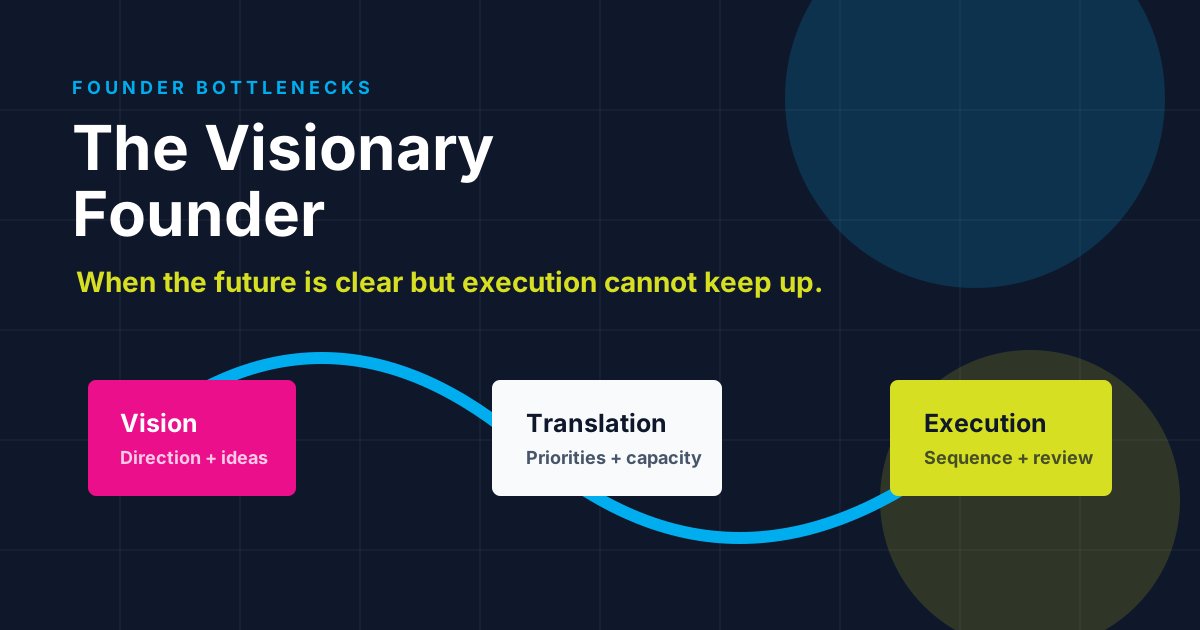
Many founders carry a clear sense of where the business should go.
You know what matters. You know which opportunities fit. You know which clients are aligned. You know which projects are distractions. You know which tradeoffs protect the long-term direction.
But the team may not have access to that same internal filter.
They may hear the vision in a meeting and still struggle to apply it on Tuesday afternoon when a client asks for an exception, a project competes for capacity, or two priorities collide.
That is the Significance and Vision Gap.
The founder carries the why, the direction, and the filter.
The team carries the tasks.
When those do not connect, the founder has to keep re-aligning the business manually.
The fix is not to give another inspirational talk.
The fix is to translate vision into operating direction.
For a practical way to connect company direction to a team priority or individual decision, see how the PROGRESS Framework maps work from micro to macro. The same map can make the relationship between the larger objective and the immediate next step visible.
Why This Happens
Founders often communicate vision as meaning, not as decision guidance.
Vision often begins as a felt sense.
The founder can see the future of the business before it is obvious to everyone else. That is part of the founder's value.
But what is obvious internally to the founder may be vague operationally to the team.
The team needs to know:
- What matters most this quarter?
- What should we say no to?
- What tradeoffs are acceptable?
- What quality standard protects the brand?
- What metric shows we are moving in the right direction?
- What decision filter should guide ambiguous situations?
Without those answers, vision stays founder-dependent.
People may agree with the direction but still need the founder to interpret it.
That keeps the founder central.
What Operating Direction Looks Like
Direction should help the team choose without waiting for the founder.
Operating direction turns vision into usable guidance.
It does not need to be complicated.
It can include a small number of priorities, clear decision filters, visible scorecards, tradeoff rules, and examples of what good looks like.
For example:
- Priority: Improve delivery reliability before adding new offers.
- Filter: Do not accept custom work that weakens repeatability.
- Scorecard: Track on-time delivery and client rework.
- Tradeoff rule: Protect quality over speed when brand trust is at risk.
- Review rhythm: Revisit strategic fit every Friday before committing capacity.
These tools help the team act in alignment without needing the founder to restate the vision every time.
The point is not to remove leadership.
The point is to make leadership more transferable.
The PROGRESS Lens
Identify where the team is busy but unclear about what matters most.
Find whether the blocker is unclear priorities, missing filters, weak scorecards, or unspoken tradeoff rules.
Define what aligned execution should look like without constant founder interpretation.
Name the human return of turning vision into usable direction: less re-explaining, better focus, and more confident ownership.
Connect the work to the larger reason the business exists and the founder's next-stage role.
Choose one recurring strategic tradeoff and turn it into a visible decision filter.
Mini Case
The founder kept explaining the same strategy.
Imagine a founder-led company with a talented team.
The founder has a clear strategic direction: move toward higher-quality clients, reduce custom delivery, and protect team capacity.
The team nods along in meetings.
But during the week, they still accept small custom requests, say yes to low-fit opportunities, and prioritize urgent client asks over the strategic work.
The founder gets frustrated.
"We talked about this already."
But the team does not have the operating filters to apply the strategy.
They need clear examples of low-fit work, a rule for custom requests, a capacity threshold, and a review rhythm for opportunity decisions.
Once those filters are installed, the founder does not need to keep re-explaining the strategy.
The team can see how the vision changes daily decisions.
What To Do Next
Translate one part of the vision into an operating filter.
Name the recurring drift
Identify where the team keeps moving away from what matters most.
Clarify the priority
State the current strategic priority in plain operational language.
Define the tradeoff
Explain what the team should choose when two good things compete.
Create the filter
Turn the priority into a short rule people can apply without you.
Review real decisions
Use weekly examples to refine the filter until it becomes usable.
Common Mistakes
Avoid mistaking agreement for alignment.
Repeating the vision without translating it
People may agree and still not know how to act.
Setting too many priorities
A crowded strategy forces the founder to keep clarifying what matters most.
Keeping tradeoffs implicit
The team needs to know what to choose when priorities compete.
Measuring activity instead of movement
Busy work can hide strategic drift.
Treating misalignment as resistance
Sometimes people are willing but lack usable guidance.
Updating direction too often
Constant shifts make the founder the only stable interpreter.