Quick Answer
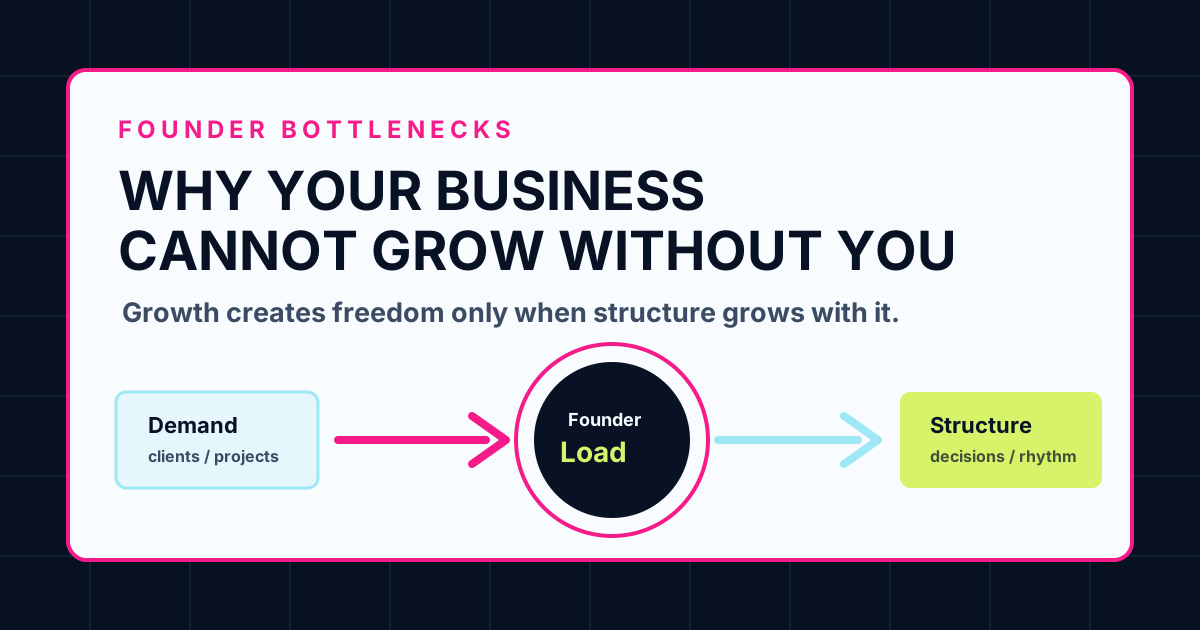
If your business still depends on you, one of six bottlenecks is usually active.
The business may depend on your memory, decisions, resources, capacity, vision, or coordination. Those are not just delegation problems. They are signs that the operating structure has not yet learned to carry what the founder still carries personally.
The practical move is to find the lead bottleneck first, then turn that part of founder judgment into a system, decision rule, resource, rhythm, or ownership structure the team can use.
The Core Idea
Founder bottlenecks are transformation points.
A founder bottleneck is not just a place where work slows down.
It is a place where the business still depends on the founder to provide something the operating system has not yet learned to carry.
Sometimes that is memory.
Sometimes it is decision-making.
Sometimes it is judgment, direction, standards, context, prioritization, or accountability.
In operator mode, the founder solves the issue personally. They answer the question, approve the work, fix the quality problem, calm the client, reset the priority, or chase the follow-up.
That works for a while.
It also teaches the business to keep routing uncertainty through the founder.
Architect mode is different.
The architect asks, "Why does this keep coming back to me, and what structure would allow the business to handle it without depending on my direct involvement every time?"
That is the shift this first article series is about.
The goal is not for the founder to disappear. The goal is for the founder to become the designer of a business that can think, decide, deliver, and improve with less personal dependence on them.
The six bottlenecks help you see where that transformation needs to happen next.
Why This Happens
The business grows faster than the operating structure.
Most founder-led companies begin with founder proximity.
The founder knows the clients. The founder understands the offer. The founder sets the quality standard. The founder remembers what was promised. The founder sees the tradeoffs. The founder knows which exceptions are acceptable and which ones create risk.
At the beginning, this is an advantage.
The company can move quickly because the founder is close to everything.
But growth changes the math.
More clients create more edge cases. More team members create more handoffs. More tools create more places for information to scatter. More revenue creates more complexity. More opportunities create more decisions. More delivery creates more quality variation.
If the operating structure does not mature, the business keeps asking the founder to absorb the complexity.
That is why a founder can have a team, tools, clients, revenue, and still feel like everything depends on them.
The issue is not effort.
The issue is translation.
The business has not yet translated enough founder judgment into systems, decision rights, resources, operating rhythm, shared direction, and ownership.
The 6 Founder Bottlenecks
1. Operational Redundancy
Operational redundancy happens when the founder keeps repeating, remembering, re-explaining, and reconnecting work that should be carried by the system.
The symptom is usually familiar: the same questions come back every week. People ask where the latest version is. Client context lives in your head. Work moves faster when you are close to it because you know the shortcuts, exceptions, and history.
In operator mode, you answer the question again.
In architect mode, you ask why the system still needs you to remember it.
This bottleneck usually points to missing operating memory: clear handoffs, documented context, reusable standards, source-of-truth systems, and repeatable workflows.
The transformation is from founder as memory to business as memory.
2. Decision Bottlenecks
Decision bottlenecks happen when the team can do the work, but cannot confidently decide without the founder.
The symptom is stalled approvals, problems brought without recommendations, Slack threads waiting for your input, and meetings where everyone looks to you to make the hard call.
This is not always a team-confidence problem. Often, the team has never been given clear decision rights.
They do not know which decisions they own, which decisions need escalation, what risk is acceptable, or which tradeoffs should guide the call.
In operator mode, you make the decision.
In architect mode, you define the decision architecture.
The transformation is from founder as decision maker to founder as designer of decision rights.
3. Resource and Tech Constraints
Resource and tech constraints happen when the business is asking people to compensate for missing tools, poor workflows, weak roles, or underpowered support.
The symptom is frustrating because it often appears after you have already invested in help. You hire someone, but they create more management. You add software, but the chaos remains. You automate part of the process, but the team still needs manual workarounds.
This bottleneck appears when resources are added on top of unclear structure.
The issue may not be that you need more tools or more people. The issue may be that the workflow, ownership, data, and decision points were never clarified before the tool or hire was added.
In operator mode, you compensate for the gap.
In architect mode, you design the support around the workflow the business actually needs.
The transformation is from founder as workaround to business as supported system.
4. Growth vs. Chaos
Growth vs. chaos happens when more success creates more pressure instead of more leverage.
The symptom is that new clients, projects, hires, and opportunities should feel like progress, but they create more coordination, more exceptions, and more noise. Revenue grows, but the business feels heavier. The same problems keep returning in larger forms.
This bottleneck usually means the operating structure was built for an earlier stage of the company.
The business may have doubled in complexity while the roles, rhythms, handoffs, and visibility stayed roughly the same.
In operator mode, you absorb the extra complexity.
In architect mode, you redesign the structure before adding more volume.
The transformation is from founder as shock absorber to business as scalable operating system.
5. Significance and Vision Gaps
Significance and vision gaps happen when the founder carries the meaning, direction, and decision filter for the business.
The symptom is not always obvious because the team may be busy. Work is happening. Projects are moving. Meetings are full. But people cannot clearly connect today's work to the bigger direction. Priorities shift. The team needs the founder to restate what matters and why.
This bottleneck forms when vision has not been translated into operating direction.
The founder may know the destination, but the team does not yet have the priorities, filters, scorecards, and tradeoff rules that make the destination usable in daily work.
In operator mode, you keep re-aligning people manually.
In architect mode, you turn vision into operating guidance.
The transformation is from founder as source of meaning to business as directionally aligned system.
6. Team Alignment Gaps
Team alignment gaps happen when people are working, but ownership does not connect cleanly across the business.
The symptom is meetings that produce updates but not decisions. Issues are discussed, but they resurface later. No one fully owns the outcome end to end. Work passes between people, but accountability gets diluted in the handoff.
This bottleneck usually points to weak ownership architecture.
The team may be capable, but the business has not clarified who owns what, how progress is reviewed, what standards apply, and how the team should resolve issues before they become founder escalations.
In operator mode, you coordinate the pieces.
In architect mode, you build the rhythm and ownership structure that lets the team coordinate itself.
The transformation is from founder as coordinator to team as accountable operating system.
The PROGRESS Lens
Identify where work, decisions, context, or ownership still routes through the founder today.
Separate the visible symptom from the lead bottleneck creating the most downstream drag.
Define what the business should be able to do without increasing founder dependence.
Name the human and business return of removing the bottleneck: time, confidence, leadership depth, and strategic capacity.
Identify the people, tools, systems, standards, decision rules, or operating support the business is missing.
Surface where the business is fragile because too much knowledge, authority, or judgment lives with one person.
Connect the fix to the founder's larger transformation from operator to architect.
Choose the next practical move that reduces the most founder dependence first.
Mini Case
The founder tried to hire their way out of the bottleneck.
Imagine a founder-led service business that is growing quickly.
The founder is tired of being in the middle of delivery, so they hire an operations manager.
For a few weeks, things feel better. There is more tracking. Meetings are more organized. Tasks are clearer. The founder feels some relief.
Then the old pattern returns.
The team still asks the founder to approve client-sensitive decisions. Delivery standards still depend on founder review. New software creates more places to update, but not more clarity. The operations manager can coordinate tasks, but cannot resolve tradeoffs without the founder.
The founder assumes the hire was the problem.
But the real issue is that the business had several bottlenecks tangled together.
There was a decision bottleneck because authority was unclear. There was operational redundancy because context lived in the founder's head. There was a team alignment gap because ownership was not tied to outcomes. There was a resource constraint because the new role was added before the workflow was redesigned.
The answer was not simply to replace the hire.
The answer was to identify the lead bottleneck and build the next layer of operating architecture around it.
Once decision rights were clarified, delivery standards were made visible, and the weekly rhythm shifted from updates to ownership, the operations manager became more useful because the system finally gave them something real to operate.
What To Do Next
Start with the bottleneck that creates the most downstream drag.
Name the repeated symptoms
List the recurring questions, approvals, quality issues, handoffs, meetings, and escalations that keep coming back to you.
Sort the symptoms into the six bottlenecks
Do not solve yet. First, see whether the issue is memory, decisions, resources, growth complexity, vision, or alignment.
Look for the lead bottleneck
Ask which bottleneck creates the most downstream drag if it stays unresolved for another 90 days.
Choose the architect shift
Define what the business needs to carry instead of you: memory, authority, support, structure, direction, or ownership.
Build one operating layer first
Fix the layer that creates the most leverage before adding more people, tools, meetings, or documentation.
Common Mistakes
Avoid fixing symptoms while the lead bottleneck stays untouched.
Fixing every bottleneck at once
Multiple bottlenecks may be present, but one usually creates the most drag right now.
Hiring before clarifying the operating gap
A new person cannot succeed if authority, workflow, standards, and ownership are still unclear.
Adding technology to a broken process
Software can speed up confusion when the underlying workflow has not been designed.
Treating team alignment as a motivation issue
People often need clearer ownership, cadence, and standards before they can own outcomes.
Keeping vision in founder language only
The team needs direction translated into priorities, filters, and operating decisions.
Mistaking relief for transformation
A temporary reduction in founder workload is not the same as building a business that depends less on the founder.