Quick Answer
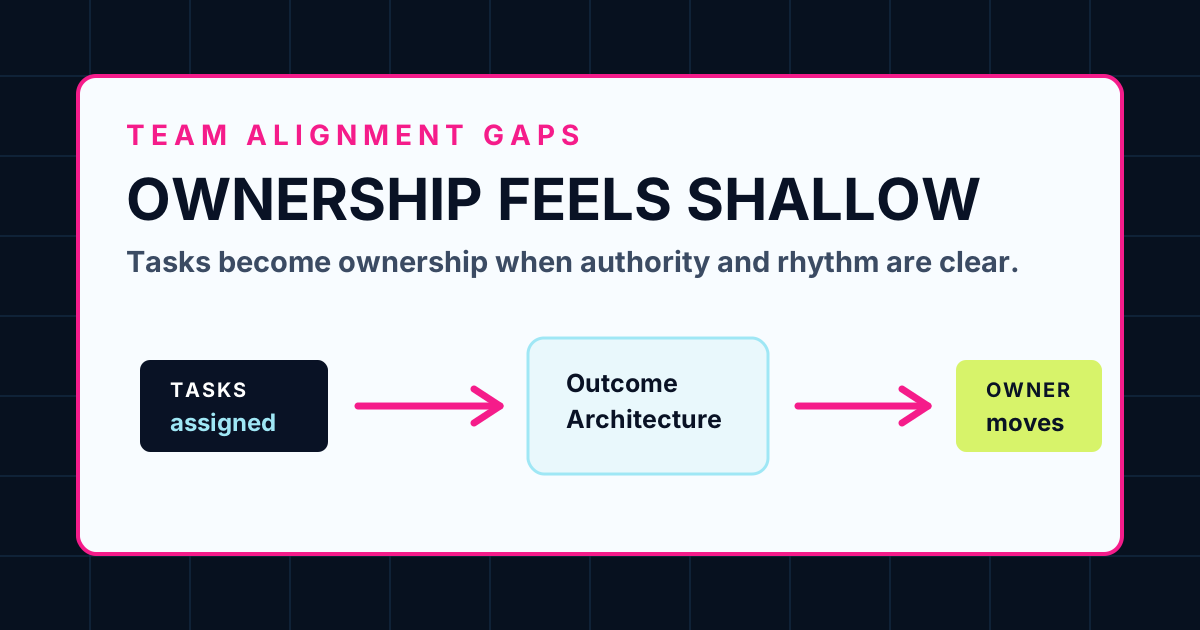
To get your team to take ownership, stop assigning only tasks and start assigning outcomes with authority and review rhythm.
If your team completes work but still waits for you to push, clarify, check, or rescue, the issue may be shallow ownership. Real ownership requires more than responsibility. It needs a clear outcome, decision rights, standards, handoff expectations, and a cadence for reviewing progress.
The Core Idea
Ownership has to be designed into how work moves.
Founders often ask for more ownership when they are tired of carrying follow-up.
They want people to see the problem, own the next step, make a judgment call, communicate early, and protect the outcome.
That is reasonable.
But many teams are operating with task responsibility, not outcome ownership.
Task responsibility says, "Do this."
Outcome ownership says:
- This is the result you own.
- This is why it matters.
- These are the decisions you can make.
- These are the standards to protect.
- These are the handoffs you must manage.
- These are the signals that tell us whether the outcome is healthy.
- This is when we review progress together.
Ownership becomes real when people can see what they own and have enough authority to move it.
If the founder still holds the context, decisions, standards, and review rhythm, the team may have tasks but not ownership.
Why This Happens
Many founder-led teams inherit work before they inherit authority.
As the business grows, founders start handing off tasks.
This is necessary.
But work often gets transferred faster than authority, context, standards, and measurement.
The team receives more work, but the founder still carries the meaning of the work.
The founder still knows which client risk matters.
The founder still knows what quality looks like.
The founder still decides priorities when work collides.
The founder still notices when the result is drifting.
That creates shallow ownership.
People are busy, but the founder remains the real owner of the outcome.
The fix is not to tell people to care more.
The fix is to make ownership concrete enough that people can practice it.
What Real Ownership Includes
Ownership needs outcome, authority, standards, visibility, and rhythm.
A usable ownership system usually includes five layers.
- Outcome: What result is this person or team responsible for?
- Authority: What can they decide without founder approval?
- Standards: What does good look like?
- Visibility: How will progress, risk, and quality be seen?
- Rhythm: When will ownership be reviewed and improved?
If any one of these is missing, ownership may feel shallow.
If the outcome is unclear, people focus on tasks.
If authority is unclear, people wait.
If standards are unclear, people ask for approval.
If visibility is unclear, problems surface late.
If rhythm is unclear, accountability becomes reactive.
Ownership is not a speech.
It is a working structure.
The PROGRESS Lens
Identify where work is assigned but the outcome still depends on founder follow-up.
Find whether the blocker is unclear outcome, weak authority, missing standards, poor handoff, or lack of visibility.
Define what real ownership should look like in behavior, decisions, and results.
Name the human return: less chasing, more confidence, and stronger team maturity.
Give the owner the context, authority, scorecard, standard, and support they need.
Surface where the business is fragile because one person owns a task but no one owns the result.
Connect ownership to the larger business direction and the founder's next-stage role.
Choose one recurring outcome and redesign ownership around it.
Mini Case
The team had tasks, but the founder still owned the outcome.
Imagine a founder-led company with a delivery team.
Each person has tasks. The work is tracked. Meetings happen weekly.
But client delivery still depends on the founder.
The founder checks whether the team is on track, notices quality drift, catches handoff gaps, and reminds people what matters.
The team is not lazy.
They do not actually own the delivery outcome.
They own pieces.
The founder redesigns the ownership layer.
One person owns delivery reliability. They have authority to adjust handoffs, flag risk early, and request resources. The team creates a simple delivery scorecard with on-time progress, client risk, and rework signals. The founder reviews the scorecard weekly instead of chasing status daily.
Ownership becomes more visible.
The founder is still a leader, but no longer the only person holding the outcome together.
What To Do Next
Turn one task owner into an outcome owner.
Pick one recurring outcome
Choose an area where you keep chasing, checking, or rescuing.
Name the owner
Decide who should own the result, not just the task.
Define success
Write what good looks like in plain operational language.
Clarify authority
Name the decisions the owner can make without you.
Add visibility
Create a simple signal, scorecard, or review point so ownership can be seen.
Review the pattern
Use a weekly rhythm to improve ownership without taking it back.
Common Mistakes
Avoid asking for ownership while keeping the operating levers yourself.
Assigning tasks instead of outcomes
People can complete tasks while the founder still owns the result.
Asking for ownership without authority
People cannot own what they are not allowed to decide.
Keeping standards invisible
If quality lives in the founder's head, ownership will keep returning to the founder.
Reviewing only when something goes wrong
Ownership grows faster with regular rhythm, not surprise correction.
Confusing silence with ownership
A lack of updates may hide risk, not maturity.
Making accountability personal too quickly
First check whether the system made ownership clear and reviewable.